|

GODINA/ YEAR: LIV. ZAGREB,
26. LISTOPADA 2017./ 26 OCTOBER, 2017 BROJ/
NUMBER: 8.2.1.
ISTRAŽIVANJE I RAZVOJ U
2016.
RESEARCH AND
DEVELOPMENT, 2016
|
U
Republici Hrvatskoj je u 2016. za istraživačko-razvojnu (IR) djelatnost
utrošeno 2,9 milijardi kuna. Od ukupnih sredstava za istraživanje i razvoj,
najviše je utrošeno u poslovnom sektoru, 44,8%. Slijedi visoko obrazovanje
s 33,3%, dok je najmanje sredstava utrošeno u državnom i privatnom
neprofitnom sektoru, 21,9%.
|
|
In
2016, a total of 2.9 billion kuna was spent on research and development
(R&D) activity in the Republic of Croatia. Of the total funds intended
for research and development, the largest amount of funds was spent in the
business enterprise sector, i.e. 44.8%. It was followed by higher education
with 33.3%, while the smallest amount of funds was spent in the government
and private non-profit sector, i.e. 21.9%.
|
|
|
|
|
|
Najveći
dio izdataka za istraživanje i razvoj odnosi se na troškove rada i troškove
naknada zaposlenima, 63,4%. Ostali tekući troškovi čine 29,1% ukupnih
izdataka, a tek 7,5% odnosi se na kapitalne izdatke.
|
|
The largest share of expenditure for
research and development was accounted for by labour costs, 63.4%. Other
current costs accounted for 29.1% of total expenditure, while capital
expenditure accounted for only 7.5%.
|
|
|
|
|
|
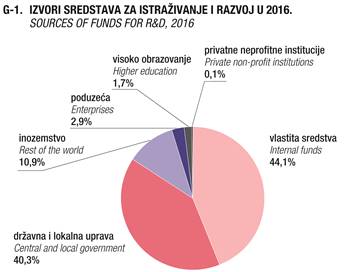
Ako
promatramo izvore sredstava za istraživanje i razvoj za sektore ukupno,
najveći dio financirale su jedinice vlastitim sredstvima, 44,1%, a slijedi
izvor državna i lokalna uprava s 40,3%. Detaljnija analiza po sektorima
pokazuje da poduzeća većinom (86,8%) financiraju IR vlastitim sredstvima,
dok su državni i privatni neprofitni sektor (76,2%) i visoko obrazovanje
(70,4%) većinski financirani od strane državne i lokalne uprave.
|
|
Observing
the sources of funds for research and development for total sectors, the
largest amount was funded by units with internal funds, 44.1%, followed by the
central and local government with 40.3%. A detailed analysis by sectors
shows that enterprises mostly finance R&D with internal funds (86.8%),
while government and private non-profit sector (76.2%) and higher education
(70.4%) are mostly financed by the central and local government.
|
|
|
|
|
|
Ukupno
zaposleni na istraživanju i razvoju su sve osobe izravno uključene u IR,
bez obzira na to jesu li zaposlenici izvještajne jedinice ili vanjski
suradnici (angažirani na poslovima IR-a na temelju ugovora o djelu ili
autorskog ugovora) koji su potpuno integrirani u aktivnosti IR-a, kao i
osobe koje pružaju izravne usluge aktivnostima IR-a (rukovodeće,
administrativno, tehničko osoblje).
|
|
Total
R&D personnel include all persons engaged directly in R&D, whether
employed by the reporting unit or external contributors (persons hired
under contractual agreement or author’s contract) fully integrated into the
unit’s R&D activities, as well as those providing direct services for
the R&D activities (such as R&D managers, administrators,
technicians).
|
|
|
|
|
|
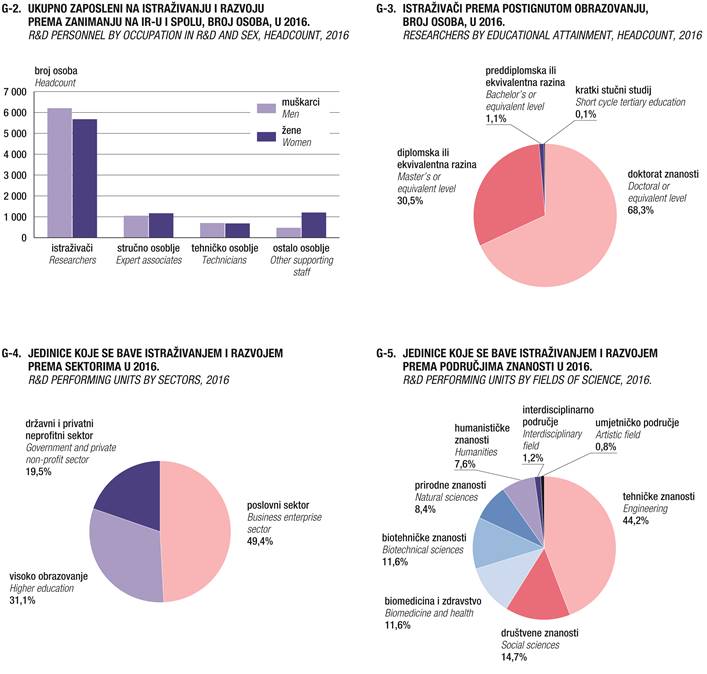
Djelatnošću
istraživanja i razvoja većinom se bave zaposlenici jedinica koje provode
IR, njih 93,3%, dok je 6,7% od ukupno zaposlenih bilo angažirano na temelju
ugovora o djelu ili autorskog ugovora. Od ukupno 17 164 zaposlenih na
istraživanju i razvoju u 2016., njih 8 734 (50,9%) jesu žene. Udio
istraživača u ukupnom broju zaposlenih jest 69,2% (među njima je 47,8%
žena). Među istraživačima ima 68,3% doktora znanosti (udio žena među
istraživačima s doktoratom jest 47,6%).
|
|
The
employees of units performing the R&D were mostly engaged in the
R&D activity, 93.3% of them, while 6.7% of the total R&D personnel
were hired under contractual agreement or author’s contract. Of the total
of 17 164 R&D personnel in 2016, 8 734 (50.9%) were women. The share of
researchers in the total R&D personnel was 69.2% (out of which 47.8%
were women). Among the researchers, there were 68.3% doctors of science
(the share of women among the researchers with a doctoral degree was
47.6%).
|
|
|
|
|
|
Istraživačko-razvojni
rad može biti osnovna djelatnost zaposlenih ili je njihova dodatna
djelatnost koju ne obavljaju puno radno vrijeme. Kako bi se realno prikazao
stvarni angažman zaposlenih na istraživanju i razvoju, prema normama
međunarodne statistike koristi se ekvivalent pune zaposlenosti (FTE). FTE
se smatra glavnim pokazateljem o zaposlenima na IR-u za međunarodne
usporedbe.
|
|
The R&D work may be the employees’
main activity or their additional activity in part-time employment. In
order to present actual engagement of R&D employees, a full-time
equivalent (FTE) is used in line with the standards of international
statistics. The FTE is considered a main indicator of R&D personnel for
the purpose of international comparison.
|
|
|
|
|
|
Izraženo
ekvivalentom pune zaposlenosti, u 2016. na istraživanju i razvoju ukupno
su bile zaposlene 10 697,4 čovjek-godine (tj. osobe koje rade puno radno
vrijeme na istraživanju i razvoju), od čega su 51,2% bile žene. Istraživača
izraženih FTE-om bilo je 7 182,4.
|
|
Expressed
as a full-time equivalent, there were a total of 10 697.4 person-years
employed in R&D in 2016 (i.e. persons in full-time employment in
R&D), out of which 51.2% were women. There were
7 182.4 researchers expressed as FTE.
|
|
|
|
|
|
U
smislu sektorske raspodjele, od 251 promatrane jedinice, poslovnom sektoru
pripadaju 124 jedinice, državnome i privatnome neprofitnom sektoru 49
jedinica, a visokom obrazovanju 78 jedinica.
|
|
Regarding
the sectoral distribution, 124 out of 251 observation units belonged to the
business enterprise sector, 49 to the government and private non-profit
sector and 78 to the higher education.
|
1. OSNOVNI POKAZATELJI ISTRAŽIVAČKO-RAZVOJNE
DJELATNOSTI U 2016.
MAIN RESEARCH AND DEVELOPMENT INDICATORS,
2016
|
|
Bruto
domaći izdaci,
tis. kuna
Gross
domestic expenditure,
thousand
kuna
|
Ukupno
zaposleni
na IR-u (broj osoba)
Total
R&D personnel (Headcount)
|
Od
toga
Of
that
|
Ukupno
zaposleni
na
IR-u (FTE)
Total
R&D personnel
(FTE)
|
Od
toga
Of
that
|
Broj j
edinica
Number
of performing units
|
|
|
|
žene
Women
|
istraživači
Researchers
|
doktori
znanosti
Doctors
of science
|
žene
Women
|
istraživači
Researchers
|
doktori
znanosti
Doctors
of science
|
|
|
|
|
|
|
|
|
|
|
|
|
|
|
|
Sektori ― ukupno
|
2
920 337
|
17
164
|
8
734
|
11
883
|
8
306
|
10
697,4
|
5
476,2
|
7
182,4
|
4
615,5
|
251
|
Sectors
− total
|
|
|
|
|
|
|
|
|
|
|
|
|
|
|
Poslovni
sektor
|
1
307 082
|
3
237
|
1
316
|
1
738
|
196
|
2
788,7
|
1
173,8
|
1
565,8
|
171,2
|
124
|
Business
enterprise sector
|
|
|
|
|
|
|
|
|
|
|
|
|
|
|
Državni i
privatni neprofitni sektor
|
639
148
|
3
906
|
2
201
|
2
346
|
2
077
|
2
942,0
|
1
718,4
|
1
658,2
|
1
493,4
|
49
|
Government
and private non-profit sector
|
|
|
|
|
|
|
|
|
|
|
|
|
|
|
Visoko
obrazovanje
|
974
107
|
10
021
|
5
217
|
7
799
|
6
033
|
4
966,7
|
2
584,0
|
3
958,4
|
2
950,9
|
78
|
Higher
education
|
2. BRUTO DOMAĆI IZDACI ZA ISTRAŽIVANJE I
RAZVOJ PREMA SEKTORIMA I VRSTAMA IZDATAKA U 2016.
GROSS DOMESTIC EXPENDITURE ON R&D, BY
SECTORS AND TYPES OF EXPENDITURES, 2016
tis. kuna
Thousand
kuna
|
|
Bruto
domaći izdaci
Gross domestic expenditure
|
Kapitalni
izdaci
Capital
expenditures
|
Tekući
izdaci
Current expenditures
|
|
|
ukupno
Total
|
troškovi
rada
i troškovi naknada zaposlenima
Labour costs
|
ostali
tekući
troškovi
Other
current costs
|
|
|
|
|
|
|
|
|
|
Sektori ― ukupno
|
2 920 337
|
218 541
|
2 701 796
|
1 850 667
|
851 129
|
Sectors
− total
|
|
|
|
|
|
|
|
|
|
Poslovni
sektor
|
1 307 082
|
132 827
|
1 174 255
|
676 691
|
497 564
|
Business
enterprise sector
|
|
|
|
|
|
|
|
|
|
Državni i
privatni neprofitni sektor
|
639 148
|
27 296
|
611 852
|
476 980
|
134 872
|
Government
and private non-profit
sector
|
|
|
|
|
|
|
|
|
|
Visoko
obrazovanje
|
974 107
|
58 418
|
915 689
|
696 996
|
218 693
|
Higher
education
|
|
|
Izdaci
za istraživanje
i razvoj,
tis. kuna
Expenditure
on R&D,
thousand
kuna
|
Ukupno
zaposleni
na IR-u
Total R&D personnel
|
Istraživači
Researchers
|
|
|
|
|
|
|
|
|
Poslovni sektor ― ukupno
|
1
307 082
|
2
788,7
|
1
565,8
|
Business
enterprise sector ― total
|
|
|
|
|
|
|
|
1 ― 9
|
5
644
|
25,2
|
14,4
|
1 ―
9
|
|
10 ―
49
|
70
817
|
289,1
|
167,3
|
10 ―
49
|
|
50 ―
249
|
403
552
|
1
060,3
|
645,5
|
50 ―
249
|
|
250 ―
499
|
61 802
|
176,0
|
125,0
|
250 ―
499
|
|
500 i više
|
765 267
|
1 238,1
|
613,6
|
500 and
more
|
tis. kuna
Thousand
kuna
|
|
Ukupno
Total
|
Vlastita
sredstva
Internal
funds
|
Državna i
lokalna uprava
Central
and
local
government
|
Poduzeća
Enterprises
|
Visoko
obrazovanje
Higher
education
|
Privatne
neprofitne
institucije
Private
non-profit institutions
|
Inozemstvo
Rest
of the world
|
|
|
|
|
|
|
|
|
|
|
|
|
Sektori ― ukupno
|
2
920 337
|
1
287 906
|
1
177 046
|
84
895
|
49
797
|
2
872
|
317
821
|
Sectors –
total
|
|
|
|
|
|
|
|
|
|
|
|
Postotak
|
100,0
|
44,1
|
40,3
|
2,9
|
1,7
|
0,1
|
10,9
|
Percentage
|
|
|
|
|
|
|
|
|
|
|
|
Poslovni sektor
|
1
307 082
|
1
134 363
|
4
394
|
27
199
|
53
|
527
|
140
546
|
Business
enterprise sector
|
|
|
|
|
|
|
|
|
|
|
|
Postotak
|
100,0
|
86,8
|
0,3
|
2,1
|
0,0
|
0,0
|
10,8
|
Percentage
|
|
|
|
|
|
|
|
|
|
|
|
Državni i privatni neprofitni sektor
|
639
148
|
57
799
|
486
934
|
37
870
|
223
|
1
394
|
54
928
|
Government
and private
non-profit sector
|
|
|
|
|
|
|
|
|
|
|
|
Postotak
|
100,0
|
9,0
|
76,2
|
5,9
|
0,0
|
0,2
|
8,6
|
Percentage
|
|
|
|
|
|
|
|
|
|
|
|
Visoko obrazovanje
|
974
107
|
95
744
|
685
718
|
19
826
|
49
521
|
951
|
122
347
|
Higher
education
|
|
|
|
|
|
|
|
|
|
|
|
Postotak
|
100,0
|
9,8
|
70,4
|
2,0
|
5,1
|
0,1
|
12,6
|
Percentage
|
5. ZAPOSLENI
NA STRAŽIVANJU I RAZVOJU PREMA VRSTI ZAPOSLENOSTI, SEKTORIMA, ZANIMANJU NA
IR-u
I SPOLU U 2016.
R&D
PERSONNEL, BY TYPE OF EMPLOYMENT, SECTORS, OCCUPATION IN R&D AND SEX,
2016
|
|
Ukupno
Total
|
Istraživači
Researchers
|
Stručno
osoblje
Expert
associates
|
Tehničko
osoblje
Technicians
|
Ostalo
osoblje
Other
supporting
staff
|
|
|
|
svega
All
|
žene
Women
|
svega
All
|
žene
Women
|
svega
All
|
žene
Women
|
svega
All
|
žene
Women
|
svega
All
|
žene
Women
|
|
|
|
|
|
|
|
|
|
|
|
|
|
|
|
|
Broj
osoba
Headcount
|
|
|
Ukupno
zaposleni na istraživanju i razvoju
|
17
164
|
8
734
|
11
883
|
5
677
|
2
221
|
1
169
|
1
383
|
684
|
1
677
|
1
204
|
Total R&D personnel
|
|
Poslovni sektor
|
3
237
|
1
316
|
1
738
|
680
|
819
|
334
|
481
|
189
|
199
|
113
|
Business enterprise sector
|
|
Državni i privatni neprofitni
sektor
|
3
906
|
2
201
|
2
346
|
1
248
|
732
|
431
|
303
|
165
|
525
|
357
|
Government and private
non-profit sector
|
|
Visoko obrazovanje
|
10
021
|
5
217
|
7
799
|
3
749
|
670
|
404
|
599
|
330
|
953
|
734
|
Higher education
|
|
|
|
|
|
|
|
|
|
|
|
|
|
|
Zaposleni
na temelju ugovora o radu
|
16
008
|
8
187
|
11
066
|
5
314
|
1
986
|
1
027
|
1
314
|
665
|
1
642
|
1
181
|
Persons working on employment
contract basis
|
|
Poslovni sektor
|
3
146
|
1
297
|
1
669
|
669
|
811
|
331
|
475
|
189
|
191
|
108
|
Business enterprise sector
|
|
Državni i privatni neprofitni
sektor
|
3
493
|
2
025
|
2
082
|
1
146
|
624
|
375
|
278
|
157
|
509
|
347
|
Government and private
non-profit sector
|
|
Visoko obrazovanje
|
9
369
|
4
865
|
7
315
|
3
499
|
551
|
321
|
561
|
319
|
942
|
726
|
Higher education
|
|
|
|
|
|
|
|
|
|
|
|
|
|
|
Angažirani
na temelju ugovora o djelu ili autorskog ugovora
|
1
156
|
547
|
817
|
363
|
235
|
142
|
69
|
19
|
35
|
23
|
Persons hired under contractual
agreement or author’s contract
|
|
Poslovni sektor
|
91
|
19
|
69
|
11
|
8
|
3
|
6
|
-
|
8
|
5
|
Business enterprise sector
|
|
Državni i privatni neprofitni
sektor
|
413
|
176
|
264
|
102
|
108
|
56
|
25
|
8
|
16
|
10
|
Government and private
non-profit sector
|
|
Visoko obrazovanje
|
652
|
352
|
484
|
250
|
119
|
83
|
38
|
11
|
11
|
8
|
Higher education
|
|
|
|
|
|
|
|
|
|
|
|
|
|
|
|
Ekvivalent
pune zaposlenosti (FTE)
Full-time
equivalent (FTE)
|
|
|
Ukupno
zaposleni na istraživanju i razvoju
|
10 697,4
|
5 476,2
|
7 182,4
|
3 488,9
|
1 535,9
|
775,7
|
939,7
|
482,1
|
1 039,4
|
729,5
|
Total
R&D personnel
|
|
Poslovni sektor
|
2 788,7
|
1 173,8
|
1 565,8
|
631,0
|
663,3
|
273,5
|
408,9
|
181,8
|
150,7
|
87,5
|
Business enterprise sector
|
|
Državni i privatni neprofitni
sektor
|
2 942,0
|
1 718,4
|
1 658,2
|
927,7
|
532,5
|
306,7
|
262,3
|
145,3
|
489,0
|
338,7
|
Government and private
non-profit sector
|
|
Visoko obrazovanje
|
4 966,7
|
2 584,0
|
3 958,4
|
1 930,2
|
340,1
|
195,5
|
268,5
|
155,0
|
399,7
|
303,3
|
Higher education
|
|
|
|
|
|
|
|
|
|
|
|
|
|
|
Zaposleni
na temelju ugovora o radu
|
10 283,8
|
5 264,9
|
6 881,8
|
3 345,5
|
1 455,2
|
720,7
|
916,8
|
476,3
|
1 030,0
|
722,4
|
Persons working on employment contract
basis
|
|
Poslovni sektor
|
2 753,8
|
1 168,0
|
1 539,3
|
628,1
|
659,1
|
271,3
|
405,9
|
181,8
|
149,5
|
86,8
|
Business enterprise sector
|
|
Državni i privatni neprofitni
sektor
|
2 852,8
|
1 678,0
|
1 596,1
|
903,4
|
514,1
|
295,7
|
258,7
|
144,1
|
483,9
|
334,8
|
Government and private
non-profit sector
|
|
Visoko obrazovanje
|
4 677,2
|
2 418,9
|
3 746,4
|
1 814,0
|
282,0
|
153,7
|
252,2
|
150,4
|
396,6
|
300,8
|
Higher education
|
|
|
|
|
|
|
|
|
|
|
|
|
|
|
Angažirani
na temelju ugovora o
djelu ili autorskog ugovora
|
413,6
|
211,3
|
300,6
|
143,4
|
80,7
|
55,0
|
22,9
|
5,8
|
9,4
|
7,1
|
Persons hired under contractual
agreement or author’s contract
|
|
Poslovni sektor
|
34,9
|
5,8
|
26,5
|
2,9
|
4,2
|
2,2
|
3,0
|
-
|
1,2
|
0,7
|
Business enterprise sector
|
|
Državni i privatni neprofitni
sektor
|
89,2
|
40,4
|
62,1
|
24,3
|
18,4
|
11,0
|
3,6
|
1,2
|
5,1
|
3,9
|
Government and private
non-profit sector
|
|
Visoko obrazovanje
|
289,5
|
165,1
|
212,0
|
116,2
|
58,1
|
41,8
|
16,3
|
4,6
|
3,1
|
2,5
|
Higher education
|
6. ISTRAŽIVAČI
PREMA VRSTI ZAPOSLENOSTI, SEKTORIMA, POSTIGNUTOM OBRAZOVANJU I SPOLU U 2016.
RESEARCHERS
BY TYPE OF EMPLOYMENT, SECTORS, EDUCATIONAL ATTAINMENT AND SEX, 2016
|
|
Ukupno
Total
|
Istraživači
prema postignutom obrazovanju
Researchers
by educational attainment
|
|
|
doktorat
znanosti
Doctoral
or equivalent level
|
diplomska
ili ekvivalentna razina
Master’s or
equivalent level
|
preddiplomska
ili ekvivalentna razina
Bachelor’s
or
equivalent level
|
kratki stučni studij
Short cycle
tertiary education
|
|
|
svega
All
|
žene
Women
|
svega
All
|
žene
Women
|
svega
All
|
žene
Women
|
svega
All
|
žene
Women
|
svega
All
|
žene
Women
|
|
|
|
|
|
|
|
|
|
|
|
|
|
|
|
|
Broj
osoba
Headcount
|
|
|
Istraživači
― ukupno
|
11
883
|
5
677
|
8
116
|
3
867
|
3
628
|
1
763
|
130
|
46
|
9
|
1
|
Researchers − total
|
|
Poslovni sektor
|
1
738
|
680
|
186
|
71
|
1
427
|
569
|
116
|
39
|
9
|
1
|
Business enterprise sector
|
|
Državni i privatni neprofitni
sektor
|
2
346
|
1
248
|
1
947
|
1
012
|
399
|
236
|
-
|
-
|
-
|
-
|
Government and private
non-profit sector
|
|
Visoko obrazovanje
|
7
799
|
3
749
|
5
983
|
2
784
|
1
802
|
958
|
14
|
7
|
-
|
-
|
Higher education
|
|
|
|
|
|
|
|
|
|
|
|
|
|
|
Zaposleni
na temelju ugovora o radu
|
11
066
|
5
314
|
7
577
|
3
642
|
3
350
|
1
625
|
130
|
46
|
9
|
1
|
Persons working on employment
contract basis
|
|
Poslovni sektor
|
1
669
|
669
|
164
|
68
|
1
380
|
561
|
116
|
39
|
9
|
1
|
Business enterprise sector
|
|
Državni i privatni neprofitni
sektor
|
2
082
|
1
146
|
1
723
|
922
|
359
|
224
|
-
|
-
|
-
|
-
|
Government and private
non-profit sector
|
|
Visoko obrazovanje
|
7
315
|
3
499
|
5
690
|
2
652
|
1
611
|
840
|
14
|
7
|
-
|
-
|
Higher education
|
|
|
|
|
|
|
|
|
|
|
|
|
|
|
Angažirani
na temelju ugovora o djelu ili autorskog ugovora
|
817
|
363
|
539
|
225
|
278
|
138
|
-
|
-
|
-
|
-
|
Persons hired under contractual
agreement or author’s contract
|
|
Poslovni sektor
|
69
|
11
|
22
|
3
|
47
|
8
|
-
|
-
|
-
|
-
|
Business enterprise sector
|
|
Državni i privatni neprofitni
sektor
|
264
|
102
|
224
|
90
|
40
|
12
|
-
|
-
|
-
|
-
|
Government and private
non-profit sector
|
|
Visoko obrazovanje
|
484
|
250
|
293
|
132
|
191
|
118
|
-
|
-
|
-
|
-
|
Higher education
|
|
|
|
|
|
|
|
|
|
|
|
|
|
|
|
Ekvivalent
pune zaposlenosti (FTE)
Full-time
equivalent (FTE)
|
|
|
Istraživači
― ukupno
|
7 182,4
|
3 488,9
|
4 489,8
|
2 215,8
|
2 570,1
|
1 231,0
|
115,5
|
41,1
|
7,0
|
1,0
|
Researchers − total
|
|
Poslovni sektor
|
1 565,8
|
631,0
|
162,1
|
65,6
|
1 287,3
|
526,5
|
109,4
|
37,9
|
7,0
|
1,0
|
Business enterprise sector
|
|
Državni i privatni neprofitni
sektor
|
1 658,2
|
927,7
|
1 399,1
|
761,9
|
259,1
|
165,8
|
-
|
-
|
-
|
-
|
Government and private
non-profit sector
|
|
Visoko obrazovanje
|
3 958,4
|
1 930,2
|
2 928,6
|
1 388,3
|
1 023,7
|
538,7
|
6,1
|
3,2
|
-
|
-
|
Higher education
|
|
|
|
|
|
|
|
|
|
|
|
|
|
|
Zaposleni
na temelju ugovora o radu
|
6 881,8
|
3 345,5
|
4 305,5
|
2 137,5
|
2 453,8
|
1 165,9
|
115,5
|
41,1
|
7,0
|
1,0
|
Persons working on employment
contract basis
|
|
Poslovni sektor
|
1 539,3
|
628,1
|
155,9
|
65,0
|
1 267,0
|
524,2
|
109,4
|
37,9
|
7,0
|
1,0
|
Business enterprise sector
|
|
Državni i privatni neprofitni
sektor
|
1 596,1
|
903,4
|
1 342,8
|
741,3
|
253,3
|
162,1
|
-
|
-
|
-
|
-
|
Government and private
non-profit sector
|
|
Visoko obrazovanje
|
3 746,4
|
1 814,0
|
2 806,8
|
1 331,2
|
933,5
|
479,6
|
6,1
|
3,2
|
-
|
-
|
Higher education
|
|
|
|
|
|
|
|
|
|
|
|
|
|
|
Angažirani
na temelju ugovora
o djelu ili autorskog ugovora
|
300,6
|
143,4
|
184,3
|
78,3
|
116,3
|
65,1
|
-
|
-
|
-
|
-
|
Persons hired under contractual
agreement or author’s contract
|
|
Poslovni sektor
|
26,5
|
2,9
|
6,2
|
0,6
|
20,3
|
2,3
|
-
|
-
|
-
|
-
|
Business enterprise sector
|
|
Državni i privatni neprofitni
sektor
|
62,1
|
24,3
|
56,3
|
20,6
|
5,8
|
3,7
|
-
|
-
|
-
|
-
|
Government and private
non-profit sector
|
|
Visoko obrazovanje
|
212,0
|
116,2
|
121,8
|
57,1
|
90,2
|
59,1
|
-
|
-
|
-
|
-
|
Higher education
|
7. JEDINICE KOJE SE BAVE ISTRAŽIVANJEM I
RAZVOJEM PREMA SEKTORIMA I PODRUČJIMA ZNANOSTI U 2016.
R&D
PERFORMING UNITS, BY SECTORS AND FIELDS OF SCIENCE, 2016
|
|
Ukupno
Total
|
Poslovni
sektor
Business
enterprise sector
|
Državni i privatni
neprofitni sektor
Government
and
private
non-profit
sector
|
Visoko
obrazovanje
Higher
education
|
|
|
|
|
|
|
|
|
|
Ukupno
|
251
|
124
|
49
|
78
|
Total
|
|
|
|
|
|
|
|
|
Prirodne
znanosti
|
21
|
3
|
8
|
10
|
Natural
sciences
|
|
Tehničke
znanosti
|
111
|
90
|
1
|
20
|
Engineering
|
|
Biomedicina
i zdravstvo
|
29
|
8
|
14
|
7
|
Biomedicine
and health
|
|
Biotehničke
znanosti
|
29
|
18
|
4
|
7
|
Biotechnical
sciences
|
|
Društvene
znanosti
|
37
|
4
|
10
|
23
|
Social
sciences
|
|
Humanističke
znanosti
|
19
|
-
|
12
|
7
|
Humanities
|
|
Umjetničko
područje
|
2
|
1
|
-
|
1
|
Artistic
field
|
|
Interdisciplinarna
područja znanosti
|
3
|
-
|
-
|
3
|
Interdisciplinary
fields of science
|
|
METODOLOŠKA OBJAŠNJENJA
|
|
NOTES ON METHODOLOGY
|
|
|
|
|
|
|
|
|
Svrha istraživanja
|
|
Purpose
of the survey
|
|
|
|
Svrha istraživanja Istraživanje
i razvoj jest praćenje
istraživačko-razvojne djelatnosti u Republici Hrvatskoj. Istraživanje se
provodi svake godine radi prikupljanja i objavljivanja podataka o
zaposlenima koji se bave istraživanjem i razvojem, izdacima i izvorima
sredstava za istraživanje i razvoj i o rezultatima istraživačko-razvojne
aktivnosti. Rezultati istraživanja omogućuju mjerenje istraživačko-razvojne
djelatnosti u Republici Hrvatskoj te predstavljaju dio podloge za donošenje
nacionalne politike o istraživačko-razvojnoj djelatnosti i praćenje njezine
provedbe. Također predstavljaju službene podatke o djelatnosti istraživanja
i razvoja u Republici Hrvatskoj koji se objavljuju u domaćim i međunarodnim
publikacijama i bazama podataka. Osim kontinuiranog praćenja razvojnih i
istraživačkih aktivnosti, istraživanje je važno i za obračun bruto domaćeg
proizvoda (BDP-a).
|
|
The
purpose of the Research and Development survey is to monitor the research and
development activity in the Republic of Croatia. The survey is conducted
every year with the aim of collecting and publishing data on R&D
personnel, expenditure and sources of funds for R&D, as well as the
results of the R&D activity. The survey results enable the measurement
of research and development activities in the Republic of Croatia and
represent a part of the basis for adopting national policy on research and
development activity and monitoring its implementation. They also
represent official data on the research and development activity in the
Republic of Croatia that are published in national and international
publications and databases. In addition to continuous monitoring of
research and development activities, the survey is important for the
calculation of gross domestic product (GDP).
|
|
|
|
|
Istraživanje se
provodi na temelju Zakona o službenoj statistici (NN, br. 103/03., 75/09.,
59/12. i 12/13. – pročišćeni tekst). Pravna osnova Europske unije za
provedbu istraživanja jest Odluka br. 1608/2003/EZ Europskog parlamenta i
Vijeća od 22. srpnja 2003. o izradi i razvoju statistike Zajednice o znanosti
i tehnologiji i Provedbena Uredba Komisije (EU) br. 995/2012 od 26.
listopada 2012. o utvrđivanju detaljnih pravila za provedbu Odluke br.
1608/2003/EZ.
|
|
The
survey is conducted on the basis of the Official Statistics Act (NN, Nos
103/03, 75/09, 59/12 and 12/13 – consolidated text). The legal basis of the
European Union for the implementation of the survey is Decision No.
1608/2003/EC of the European Parliament and of the Council of 22 July 2003
concerning the production and development of Community statistics on
science and technology and Commission Implementing Regulation (EU) No.
995/2012 of 26 October 2012 laying down detailed rules for the
implementation of Decision No 1608/2003/EC.
|
|
|
|
|
|
|
|
|
Izvori i metode prikupljanja podataka
|
|
Sources
and methods of data collection
|
|
|
|
|
Podaci
su dobiveni statističkom obradom godišnjih izvještaja prikupljenih od
pravnih jedinica koje su obavljale djelatnost istraživanja i razvoja u
Republici Hrvatskoj u kalendarskoj godini 2016. Poslovni sektor ispunjavao
je Godišnji izvještaj o istraživanju i razvoju za poduzeća (obrazac IR-1),
državni i privatni neprofitni sektor ispunjavali su Godišnji izvještaj o
istraživanju i razvoju za državni sektor i privatne neprofitne organizacije
(obrazac IR-2), a visoka učilišta ispunjavala su Godišnji izvještaj o
istraživanju i razvoju za visoko obrazovanje (obrazac IR-3). Obrasci su
poslani izvještajnim jedinicama putem elektroničke pošte, zajedno s općim
uputama i prilozima potrebnima za ispunjavanje obrasca. Izvještajne
jedinice vraćale su ispunjene izvještaje na isti način.
|
|
Data
are the result of statistical processing of annual reports collected from
legal units dealing with the R&D in the Republic of Croatia in the 2016
calendar year, from business sector on the Annual Report on R&D for
Enterprises (IR-1 form), from government and private non-profit sector on
the Annual Report on R&D for Government and Private Non-Profit Sector
(IR-2 form) and from institutions of higher education on the Annual Report
on R&D for Higher Education (IR-3 form). The forms were sent to the
reporting units via electronic mail, along with general instructions and
attachments required to fill out the forms. The reporting units returned
the filled forms in the same way.
|
|
|
|
Referentno razdoblje na koje se
odnose podaci o zaposlenima i izdacima za istraživanje i razvoj jest cijela
2016.
|
|
The
reference period to which data on R&D personnel and expenditure refer
is the entire 2016.
|
|
|
|
|
Prema
Zakonu o službenoj statistici (NN, br. 103/03., 75/09., 59/12. i 12/13. –
pročišćeni tekst) zajamčena je tajnost svih podataka koje izvještajne
jedinice daju u obrascu. Prikupljeni podaci upotrebljavaju se isključivo za
statističke svrhe i objavljuju u agregiranom obliku.
|
|
Pursuant
to the Official Statistics Act (NN, Nos 103/03, 75/09, 59/12 and 12/13 –
consolidated text), the confidentiality of all data provided by the
reporting units in the form is guaranteed. The data collected are used
solely for statistical purposes and are published in aggregated form.
|
|
|
|
|
|
|
|
|
Obuhvat
i usporedivost
|
|
Coverage
and comparability
|
|
|
|
|
Statističkim
istraživanjem "Istraživanje i razvoj u 2016." obuhvaćaju se
pravne jedinice u Republici Hrvatskoj za koje se zna ili pretpostavlja da
se bave istraživanjem i razvojem. Kako bismo identificirali pravne jedinice
koji se bave istraživanjem i razvojem, koristili smo se s više izvora, a to
su: Upisnik znanstvenih organizacija Ministarstva znanosti i obrazovanja,
Istraživanje o inovacijskim aktivnostima poduzeća (poduzeća koja su navela
da se bave istraživanjem i razvojem), statistički poslovni registar
Državnog zavoda za statistiku (pravne jedinice čija je glavna djelatnost
NKD-a 72 Znanstveno istraživanje i razvoj), prethodna istraživanja
Istraživanje i razvoj i baza podataka projekata Obzor 2020 za Republiku
Hrvatsku o dodijeljenim sredstvima po prijaviteljima (baza EU_CORDIS).
Ukupan broj jedinica kojima je poslan obrazac bio je 340. Ispunjen obrazac
dostavila je 251 jedinica. Podaci u ovom Priopćenju prikazuju agregirane
rezultate za 251 jedinicu koja se bavi istraživanjem i razvojem.
|
|
The
statistical survey entitled Research and Development in 2016 covers legal
units on the territory of the Republic of Croatia engaged in the research
and development activity. In order to identify legal units
engaged in the research and development activity, a number of sources have
been used: Register of Scientific Organisations of the Ministry of Science
and Education, Survey on Innovation Activities in Croatian Enterprises
(enterprises that indicated that they are engaged in research and
development activities), Statistical Business Register of the Croatian
Bureau of Statistics (legal units whose main activity is NKD 72 Scientific
research and development), previous Research and Development surveys and
the project database within the Horizon 2020 programme for the Republic of
Croatia for data on funds allocated by applicants (EU_CORDIS base). The
form was sent to a total of 340 units. The completed form was submitted by
251 units. Data in this First Release present aggregate results for 251
units engaged in the research and development activity.
|
|
|
|
|
|
Podaci
za 2016. objavljeni u ovom Priopćenju nisu u potpunosti usporedivi s
podacima iz prethodnih godina zbog unapređenja više procesa statističke
proizvodnje te je došlo do prekida u vremenskoj seriji. Metodologija istraživanja
revidirana je u skladu s priručnikom Frascati 2015. i Eurostatovim
metodološkim smjernicama o implementaciji priručnika Frascati 2015. i
metodološkoj harmonizaciji statistike istraživanja i razvoja u državama
Europske unije. Slijedom toga došlo je do promjena u definicijama te su
detaljnije raščlanjeni pojedini metodološki koncepti u obrascu. Unaprijeđen
je proces prikupljanja i obrade podataka. Instrument za prikupljanje
podataka jest elektronički obrazac u obliku Excela s ugrađenim kontrolama i
metodološkim objašnjenjima. U prikupljanju primarnih podataka uvedene su
dodatne kontrole, što je zajedno s ponovnim kontaktiranjem izvještajnih
jedinica utjecalo na smanjenje stope neodgovora na pojedine stavke.
Prelaskom na elektroničko prikupljanje podataka unaprijeđen je proces
obrade podataka,
logičko-računske kontrole i tabeliranja.
|
|
The
2016 data published in this First Release are not fully comparable with
data from previous years due to the improvement of a number of statistical
production processes and the interruption in time series. The methodology
for the survey has been revised in accordance with the Frascati Manual 2015
and Eurostat’s methodological guidelines for the implementation of the
Frascati Manual 2015 and the methodological harmonisation of the research
and development statistics in the European Union countries. Consequently,
definitions have been changed and certain methodological concepts have been
broken down in more detail in the form. Furthermore, the process of data
collection and processing has been improved. The data collection instrument
is an electronic form in Excel with embedded controls and notes on
methodology. Additional controls have been introduced with regard to the
collection of primary data, which, along with repeated contacting of
reporting units, had the effect of reducing the non-response rate for
certain items. The switch to electronic data collection improved data
processing, data editing and tabulation.
|
|
|
|
|
|
Izvještajne
jedinice u poslovnom sektoru klasificiraju se u jednu od posebno formiranih
skupina djelatnosti prema NKD-u 2007. prema glavnoj djelatnosti NKD-a u
statističkome poslovnom registru Državnog zavoda za statistiku, za razliku
od prethodnih godina kada su bile klasificirane u skupinu djelatnosti prema
pretežnosti, tj. prema djelatnosti s najvećim udjelom izdataka za
istraživanje i razvoj.
|
|
The
reporting units in the business enterprise sector are classified into one
of the specially formed activity groups according to NKD 2007. by the main
NKD activity in the Statistical Business Register of the Croatian Bureau of
Statistics, as compared to the previous years, when they were classified
into the activity group by predominance, that is, by the activity with the
highest share of R&D expenditure.
|
|
|
|
|
|
Referentno
razdoblje na koje se odnose podaci o zaposlenima jest cijela 2016., dok su
u prethodnim godinama podaci o zaposlenima prikupljani sa stanjem na dan
31. prosinca.
|
|
The
reference period to which data on R&D personnel refer is the entire
2016., while in previous years, data on R&D personnel were collected
with the situation as on 31 December.
|
|
|
|
|
|
Zbog
svih navedenih razloga u 2016 došlo. je do prekida u vremenskoj seriji.
|
|
Due to
the aforementioned reasons, there was an interruption in time series in
2016.
|
|
|
|
|
|
Do
1996. provodilo se istraživanje NIRO – Godišnji izvještaj za
znanstveno-istraživačke i istraživačko-razvojne pravne osobe, koje je
obuhvaćalo sve znanstveno-istraživačke pravne osobe i istraživačke jedinice
u sastavu poduzeća i ustanova te sva visoka učilišta koja su u kalendarskoj
godini bila upisana u Upisnik Ministarstva znanosti i tehnologije Republike
Hrvatske.
|
|
Until
1996, the statistics on scientific research was compiled by means of the
Annual Report for Legal Entities Engaged in Science and Research and Legal
Entities Engaged in Research and Development (NIRO form), which covered all
legal entities engaged in science and research as well as research units
within enterprises and institutions, and all institutions of higher
education that were recorded with the Register of the Ministry of Science
and Technology of the Republic of Croatia in the referent year.
|
|
|
|
|
|
Na
temelju međunarodne metodologije – priručnika Frascati 2002. – počevši od
1997. uvodi se sektorski pristup kojem je cilj proširenje poslovnog sektora
kao osnovnog nositelja istraživanja i razvoja u svijetu. Podaci za
razdoblje od 1997. do 2003. prikupljeni su od poduzeća sa 100 i više
zaposlenih, podaci za 2004. prikupljeni su od poduzeća s 10 i više
zaposlenih, a od 2005. u obuhvat ulaze i poduzeća s manje od 10
zaposlenih i privatni neprofitni sektor. Zbog malog broja jedinica podaci
za privatni neprofitni sektor od 2013. prikupljaju se i objavljuju zajedno
s podacima za državni sektor.
|
|
Since
1997, the sector approach has been introduced, based on the international
methodology – The Frascati Manual 2002 – and aimed at the expansion of the
business enterprise sector as the principal domain of research and
development in the world. Data for the period from 1997 to 2003 were
collected from business enterprises employing more than 100 persons, the
2004 data were collected from business enterprises employing more than 10
persons and, since 2005, enterprises with less than 10 employees as well as
private non-profit sector have been covered. Since 2013, the private
non-profit sector has been presented together with the government sector
due to the small number of units.
|
|
|
|
|
|
|
|
|
Definicije i objašnjenja
|
|
Definitions
and explanations
|
|
|
|
|
|
Definicije
područja istraživanja i razvoja temelje se na međunarodnoj metodologiji –
priručniku Frascati 2015. (Frascati Manual 2015: Guidelines for
Collecting and Reporting Data on Research and Experimental Development, The
Measurement of Scientific, Technological and Innovation Activities, izdavač:
OECD, Pariz, 2015.).
|
|
Definitions
of the R&D field are based on the international methodology – the
Frascati Manual 2015 (Frascati Manual 2015: Guidelines for Collecting and
Reporting Data on Research and Experimental Development, The Measurement of
Scientific, Technological and Innovation Activities, publisher:
Organisation for Economic Co-operation and Development – OECD, Paris,
2015).
|
|
|
|
|
|
Istraživanje
i razvoj jest kreativni sustavni stvaralački rad s ciljem
uvećavanja količine znanja uključujući znanja o čovjeku, kulturi i društvu,
kao i osmišljavanje novih primjena dostupnog znanja. Da bi neka aktivnost
bila istraživanje i razvoj, mora zadovoljiti pet kriterija. Aktivnost mora
biti: originalna (nova), kreativna, neizvjesna, sustavna i prenosiva i/ili
ponovno izvediva. Pojam istraživanja i razvoja obuhvaća tri vrste
aktivnosti: temeljna, primijenjena i razvojna istraživanja.
|
|
Research
and development (R&D) comprise systematic creative
work aimed at increasing knowledge about nature, man, culture and society
and its application in practice. For an activity to
be an R&D activity, it must satisfy five criteria. The activity must be
novel, creative, uncertain, systematic and transferable and/or
reproducible. There are three types of research and development: basic
research, applied research and experimental development.
|
|
|
|
|
|
Temeljno
istraživanje jest teorijski ili pokusni rad poduzet ponajprije
radi postignuća novih znanja o osnovama pojava i činjenica bez konkretne
praktične primjene.
|
|
Basic
research is a theoretical or experimental work,
which mainly aims at attaining to new knowledge about basics of phenomena
and facts with no practical application.
|
|
|
|
|
|
Primijenjeno
istraživanje jest teorijski ili pokusni rad poduzet ponajprije
radi postignuća novih znanja i usmjeren prije svega na ostvarivanje
praktičnog cilja.
|
|
Applied
research is a theoretical or experimental work,
which mainly aims at attaining to new knowledge and which is primarily
focused on achieving practical objectives.
|
|
|
|
|
|
Razvojno
istraživanje jest sustavan rad temeljen na postojećim rezultatima
znanstvenog istraživanja i praktičnog iskustva, usmjeren stvaranju novih
materijala, proizvoda ili sustava te uvođenju novih procesa, sustava i
usluga ili znatnom poboljšanju postojećih.
|
|
Experimental
development is a systematic work based on the
results of scientific research and practical experience, aimed at creating
new materials, products and systems as well as at introducing new or
improving existing processes.
|
|
|
|
|
|
Poslovni
sektor obuhvaća
poduzeća čija je glavna djelatnost proizvodnja roba i usluga za tržište po
ekonomskoj cijeni. Poslovni sektor uključuje i javna poduzeća, kao i
neprofitne institute koji su usmjereni na tržište.
|
|
Business
enterprise sector comprises enterprises and organisations
the main activity of which is production of goods and services intended for
market at commercial price. The business enterprise sector
includes public enterprises, as well as non-profit institutions that are
market producers of goods or services.
|
|
|
|
|
|
Državni
sektor obuhvaća
sve jedinice središnje i lokalne države, uključujući fondove socijalne
sigurnosti, osim visokih učilišta, kao i sve neprofitne institucije koje
nisu usmjerene na tržište, a kontrolira ih država i nisu dio sektora
visokog obrazovanja.
|
|
Government
sector comprises all units of central and local
government, including social security funds, except higher education
insitutions, as well as all nonmarket non-profit institutions that are
controlled by government units, and that are not themselves part of the
Higher education sector.
|
|
|
|
|
|
Privatni
neprofitni sektor obuhvaća neprofitne organizacije koje
pružaju netržišna dobra ili usluge kućanstvima, tj. široj javnosti, osim
onih koje kontrolira i uglavnom financira država, a njihovo je osnovno
obilježje da ne mogu biti izvor dohotka ili dobiti jedinicama koje ih
kontroliraju.
|
|
Private
non-profit sector comprises non-market, non-profit
institutions serving households (that is, the general public), except those
mainly controlled and financed by government, their main characteristic
being that they should not be the source of revenue or profit to the
institutions controlling them.
|
|
|
|
|
|
Visoko
obrazovanje obuhvaća sva visoka učilišta koja pružaju programe
formalnoga tercijarnog obrazovanja bez obzira na izvor financiranja ili
pravni status, kao i sve istraživačke institute i centre čije su
istraživačko-razvojne aktivnosti pod izravnom kontrolom ili kojima
upravljaju ustanove tercijarnog obrazovanja.
|
|
Higher
education includes all institutions providing
formal tertiary education programmes, whatever their source of finance or
legal status, and all research institutes and centres that have their
R&D activities under the direct control of, or administered by,
tertiary education institutions.
|
|
|
|
|
|
Bruto
domaći izdaci za istraživanje i razvoj jesu ukupni
unutarnji izdaci za istraživanje i razvoj na području države u promatranoj
kalendarskoj godini. Uključuju istraživanje i razvoj proveden u zemlji
financiran iz inozemstva, ali isključuju financiranje istraživanja i
razvoja provedenog u inozemstvu. Unutarnji izdaci za istraživanje i razvoj
jesu svi tekući izdaci i kapitalni izdaci u bruto iznosima za istraživanje
i razvoj proveden u izvještajnoj jedinici, neovisno o izvoru sredstava.
|
|
Gross
domestic expenditure on R&D (GERD) is the
total intramural expenditure on R&D performed in the national territory
during the reporting calendar year. GERD includes domestically performed
R&D that is financed from abroad but excludes funding for R&D
performed abroad. Intramural R&D expenditures are all current
expenditures and gross fixed capital expenditures for R&D performed
within reporting unit, irrespective of the source of funds.
|
|
|
|
|
|
Tekući
izdaci obuhvaćaju
troškove rada i troškove naknada zaposlenima te ostale tekuće troškove.
|
|
Current
expenditures comprise labour costs and other current
costs used in R&D.
|
|
|
|
|
|
Troškovi
rada i troškovi naknada zaposlenima obuhvaćaju bruto
place i naknade bruto plaća, socijalne doprinose koje plaća poslodavac,
troškove obrazovanja i ostale troškove rada.
|
|
Labour
costs include compensations of employees (wages and
salaries and social contributions paid by an employer), vocational training
costs and other labour costs.
|
|
|
|
|
|
Ostali
tekući troškovi obuhvaćaju materijalne troškove, isplate
na temelju ugovora o djelu i autorskih ugovora, nabavu usluge povezanih s
IR-om i druge izdatke (izdatke za indirektne usluge).
|
|
Other
current costs comprise material costs, costs of
persons hired under contractual agreement of author’s contract, acquiring
services to support intramural R&D and other costs (costs of indirect
services).
|
|
|
|
|
|
Kapitalni
izdaci su
godišnji bruto iznosi plaćeni za nabavu fiksnih dobara koja se koriste u
istraživanju i razvoju kontinuirano ili u više navrata više od jedne godine.
Obuhvaćaju ulaganja u zemljišta i zgrade, postrojenja i opremu, računalni
softver i patente, licencije, studije i projekte.
|
|
Capital
expenditures are the annual gross amount paid for the
acquisition of fixed assets that are used repeatedly or continuously in the
performance of R&D for more than one year. They comprise investing in
land and buildings, machinery and equipment, computer software and patents,
licences, studies and projects.
|
|
|
|
|
|
Ukupno
zaposleni na istraživanju i razvoju jesu sve osobe izravno
uključene u IR, bez obzira na to jesu li zaposlenici izvještajne jedinice
ili vanjski suradnici (angažirani na poslovima IR-a na temelju ugovora o
djelu ili autorskog ugovora) koji su potpuno integrirani u aktivnosti IR-a,
kao i osobe koje pružaju izravne usluge aktivnostima IR-a (rukovodeće,
administrativno, tehničko osoblje). Prema preporukama priručnika Frascati
ne uzimaju se u obzir osobe koje na istraživanju i razvoju rade manje od
10% punoga radnog vremena.
|
|
Total
R&D personnel include all persons engaged directly in
R&D, whether employed by the reporting unit or external contributors
(persons hired under contractual agreement or author’s contract) fully
integrated into the unit’s R&D activities, as well as those providing
direct services for the R&D activities (such as R&D managers,
administrators, technicians). According to the recommendations of the
Frascati Manual 2015, persons who work less than 10% of full-time hours are
not included.
|
|
|
|
|
|
Istraživači su
stručnjaci koji se bave stvaranjem novog znanja. Oni provode istraživanje i
poboljšavaju i razvijaju koncepte, teorije, modele, postupke, softver ili
operativne metode.
|
|
Researchers are
professionals engaged in the conception or creation of new knowledge. They
conduct research and improve or develop concepts, theories, models,
techniques instrumentation, software or operational methods.
|
|
|
|
|
|
Tehničko
osoblje jesu oni zaposleni čiji glavni zadaci zahtijevaju
tehničko znanje i iskustvo u jednome ili više polja tehničkih, prirodnih,
društvenih i humanističkih znanosti i umjetnosti. Oni u istraživanju i
razvoju obavljaju znanstvene i tehničke zadatke koji uključuju primjenu
koncepata i operativnih metoda i korištenje istraživačke opreme, obično pod
nadzorom istraživača.
|
|
Technicians
and equivalent staff are persons whose main tasks
require technical knowledge and experience in one or more fields of
engineering, the physical and life sciences, or the social sciences,
humanities and the arts. They participate in R&D by performing
scientific and technical tasks involving the application of concepts and
operational methods and the use of research equipment, normally under the
supervision of researchers.
|
|
|
|
|
|
Stručno
osoblje
jesu osobe u pravilu s visokim obrazovanjem zaposlene na stručnim radnim
mjestima (knjižničari, informatičari, informacijski stručnjaci itd.) koje
sudjeluju u znanstveno-istraživačkom i istraživačko-razvojnom radu, međutim
nisu nositelji istraživačko-
razvojnih projekata.
|
|
Expert
associates are persons with higher education
employed to perform expert jobs (librarians, IT professionals, information
specialists, etc.), who participate in the scientific and research and
R&D work, but are not the managers of R&D projects.
|
|
|
|
|
|
Drugo
osoblje (pomoćno) jesu oni zaposleni koji obavljaju sve aktivnosti
koje izravno doprinose izvođenju IR-a a koje ne obavljaju istraživači ili
tehničko i stručno osoblje. Te aktivnosti uključuju tajničke i druge
administrativne poslove, upravljanje materijalima ili uređajima potrebnima
za izvođenje projekta IR-a, potporne aktivnosti povezane s IR-om kao što su
planiranje, informacijska i financijska potpora, pravne usluge, pomoć u
sastavljanju, prilagodbi, održavanju i popravku znanstvene opreme i
instrumenata. Ovdje je uključeno i rukovodeće i administrativno osoblje
koje se uglavnom bavi financijskim i kadrovskim pitanjima i općom
administracijom ako su njihove aktivnosti izravno povezane s projektima
IR-a.
|
|
Other
supporting staff are employees who perform all the
activities that directly contribute to the R&D performance, which are
not performed by researchers or technicians and expert associates. These
activities include secretarial and other administrative tasks, the
management of materials or equipment required for the R&D project
implementation, supporting activities related to R&D such as planning,
information and financial support, legal services, assistance in the
assembly, adjustment, maintenance and repair of scientific equipment and
instruments. Managerial and administrative staff who mainly deal with financial
and personnel issues and general administration also perform the
aforementioned activities if their activities are directly related to
R&D projects.
|
|
|
|
|
|
Ekvivalent
pune zaposlenosti iskazuje se u čovjek-godinama, a
predstavlja vrijeme kao udio punoga radnog vremena u kojem zaposleni
obavljaju poslove iz područja istraživanja i razvoja (npr. ako je jedna
osoba radila na poslovima istraživanja i razvoja šest mjeseci u punome
radnom vremenu, to se prikazuje kao 0,5 ekvivalenta pune zaposlenosti).
|
|
Full-time
equivalent (FTE) is expressed in person-years and
presents time as a share of full working time in which persons in
employment are engaged in the work related to research and development (for
example, if a person was engaged in works related to research and
development for six months in full working time, it is expressed as 0.5
full-time equivalent – 0.5 FTE).
|
|
|
|
|
|
|
|
|
|
Kratice
|
|
Abbreviations
|
|
|
|
|
EU
|
Europska unija
|
|
EU
|
European Union
|
FTE
|
ekvivalent pune zaposlenosti
|
|
FTE
|
full-time
equivalent
|
|
IR
|
istraživanje i
razvoj
|
|
i.e.
|
that is
|
|
OECD
|
Organizacija za
ekonomsku suradnju i razvoj
|
|
OECD
|
Organisation for
Economic Co-operation and Development
|
|
tis.
|
tisuća
|
|
R&D
|
Research and
Development
|
|
|
|
|
|
|
|
|
Znakovi
|
|
Symbols
|
|
|
|
|
-
|
nema pojave
|
|
-
|
no
occurrence
|
|
0,0
|
podatak je manji od 0,05 upotrijebljene mjerne
jedinice
|
|
0.0
|
value
not zero but less than 0.05 of the unit of measure used
|
|
|
|
|
|
|
|
Objavljuje
i tiska Državni zavod za statistiku Republike Hrvatske, Zagreb, Ilica 3, p.
p. 80.
Published and printed by the Croatian Bureau of
Statistics, Zagreb, Ilica 3, P. O. B. 80
Telefon/ Phone:
+385 (0) 1 4806-111, telefaks/ Fax: +385 (0) 1 4817-666
Odgovara
ravnatelj Marko Krištof.
Person
responsible: Marko Krištof, Director General
Priredile:
Matija Škegro Vdović, Ivana Goda i Marija Avilov
Prepared
by: Matija Škegro Vdović, Ivana Goda and Marija Avilov
|
|
MOLIMO KORISNIKE DA PRI KORIŠTENJU
PODATAKA NAVEDU IZVOR.
USERS
ARE KINDLY REQUESTED TO STATE THE SOURCE
|
|
Naklada:
20 primjeraka
20 copies
printed
Podaci iz
ovog Priopćenja objavljuju se i na internetu.
First
Release data are also published on the Internet.
|