| * |
corrected data |
| - |
no occurrence |
| ... |
data not available |
| . |
not zero, but not published due to the extremely inaccurate estimation |
| p |
less accurate estimation |
| ( ) |
less accurate data |
| bn |
billion |
| CEFTA |
Central European Free Trade Agreement |
| CHP |
combined heat and power generation |
| DWT |
deadweight tonne |
| ECOICOP ver. 2 |
Classification of Individual Consumption according to Purpose, version 2 |
| EU |
European Union |
| GDP |
gross domestic product |
| GT |
gross tonnage (gross registered tonnage) |
| GWh |
gigawatt hour |
| ha |
hectare |
| kg |
kilogram |
| km |
kilometre |
| km2 |
square kilometre |
| kW |
kilowatt |
m2 |
square metre |
| m3 |
cubic metre |
| MIGs 2009 |
Main Industrial Groupings 2009 |
| mln |
million |
| NIP |
Nomenclature of Industrial Products |
| NKD 2007 |
National Classification of Activities, 2007 version |
| NN |
Narodne novine, official gazette of the Republic of Croatia |
| NPISH |
non-profit institutions serving households |
| POS |
Programme of State-Subsidised Housing Construction |
| t |
tonne |
| '000 |
thousand |
| VAT |
value added tax |
Published by the Croatian Bureau of Statistics, Zagreb, Ilica 3, P. O. B. 80
Phone: (+385 1) 48 06 111
Web site: dzs.gov.hr
Press corner: press@dzs.hr
Persons responsible:
Andrea Galić Nagyszombaty, Director of Statistical Methodologies, Quality and Customer Relations Directorate
Mario Vlajčević, Director of Demographic and Social Statistics Directorate
Suzana Šamec, Director of Macroeconomic Statistics Directorate
Edita Omerzo, Director of Spatial Statistics Directorate
Milenka Primorac Čačić, Director of Business Statistics Directorate
Lidija Brković, Director General
Prepared by: Kristijan Jurić and Krunoslav Stažić
Editor: Ljiljana Ostroški
Technical Editor: Ankica Bajzek Cesar
Language Editor: Maja Gregorić
Translator: Neda Batinić
Graphic Design: Sanja Huseinagić and Nino Mrša
ISSN 3044-1692
USERS ARE KINDLY REQUESTED TO STATE THE SOURCE WHEN USING THE DATA
Poverty is defined as a lack of financial means necessary to meet basic life needs and it is one of the greatest challenges society faces. Regular monitoring of the basic statistical poverty indicators can give insight into a deeper understanding of the causes and consequences of this multidimensional problem as well as provide a basis for developing effective policies that can diminish this phenomenon and improve the quality of life of the most vulnerable social groups.
The at-risk-of-poverty rate is a basic poverty indicator. It does not present the actual number of persons in poverty, but rather how many of them have an income below the at-risk-of-poverty threshold. In 2025, it reached 19.5%, which was 0.8 percentage points less than in 2024.
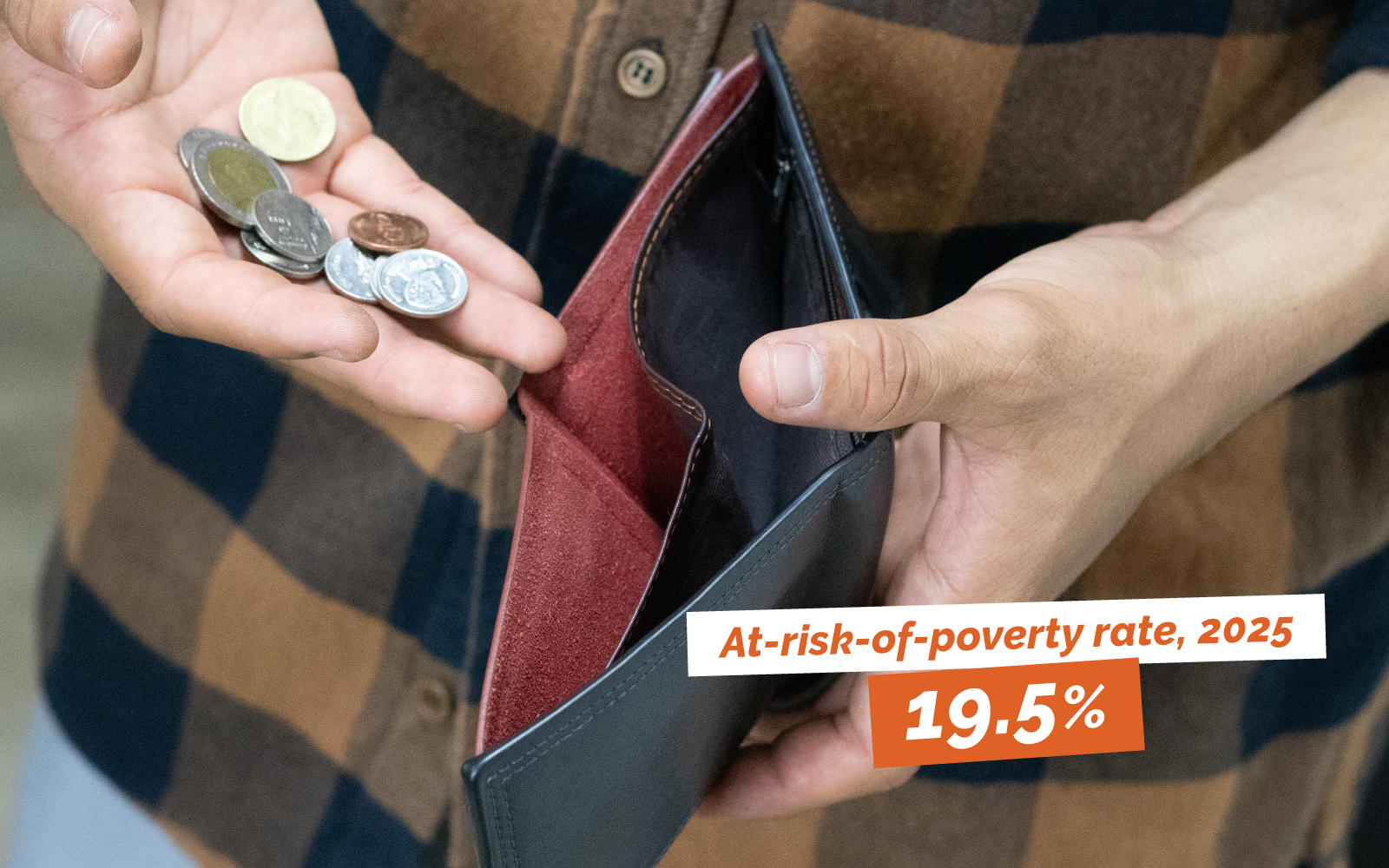
The at-risk-of-poverty rate by the most frequent activity status is calculated for persons aged 18 years and over according to the status in which a person stayed for at least seven months in a reference period. As expected, self-employed and employees had a lower at-risk-of-poverty rate compared to the unemployed, retired and other inactive persons.
In 2025, the at-risk-of-poverty threshold amounted to 9 034 euro per year for a one-person household, which means it increased by 1 627 euro compared to 2024, while for a household consisting of two adults and two children it was 18 972 euro, which was annually 3 418 euro above the 2024 threshold.
← Previous Next →

 Hrvatski
Download data