| * |
corrected data |
| - |
no occurrence |
| ... |
data not available |
| . |
not zero, but not published due to the extremely inaccurate estimation |
| p |
less accurate estimation |
| ( ) |
less accurate data |
| bn |
billion |
| CEFTA |
Central European Free Trade Agreement |
| CHP |
combined heat and power generation |
| DWT |
deadweight tonne |
| ECOICOP ver. 2 |
Classification of Individual Consumption according to Purpose, version 2 |
| EU |
European Union |
| GDP |
gross domestic product |
| GT |
gross tonnage (gross registered tonnage) |
| GWh |
gigawatt hour |
| ha |
hectare |
| kg |
kilogram |
| km |
kilometre |
| km2 |
square kilometre |
| kW |
kilowatt |
m2 |
square metre |
| m3 |
cubic metre |
| MIGs 2009 |
Main Industrial Groupings 2009 |
| mln |
million |
| NIP |
Nomenclature of Industrial Products |
| NKD 2007 |
National Classification of Activities, 2007 version |
| NN |
Narodne novine, official gazette of the Republic of Croatia |
| NPISH |
non-profit institutions serving households |
| POS |
Programme of State-Subsidised Housing Construction |
| t |
tonne |
| '000 |
thousand |
| VAT |
value added tax |
Published by the Croatian Bureau of Statistics, Zagreb, Ilica 3, P. O. B. 80
Phone: (+385 1) 48 06 111
Web site: dzs.gov.hr
Press corner: press@dzs.hr
Persons responsible:
Andrea Galić Nagyszombaty, Director of Statistical Methodologies, Quality and Customer Relations Directorate
Mario Vlajčević, Director of Demographic and Social Statistics Directorate
Suzana Šamec, Director of Macroeconomic Statistics Directorate
Edita Omerzo, Director of Spatial Statistics Directorate
Milenka Primorac Čačić, Director of Business Statistics Directorate
Lidija Brković, Director General
Prepared by: Kristijan Jurić and Krunoslav Stažić
Editor: Ljiljana Ostroški
Technical Editor: Ankica Bajzek Cesar
Language Editor: Maja Gregorić
Translator: Neda Batinić
Graphic Design: Sanja Huseinagić and Nino Mrša
ISSN 3044-1692
USERS ARE KINDLY REQUESTED TO STATE THE SOURCE WHEN USING THE DATA
Agriculture is most certainly one of the pillars of the economy, and monitoring the production, prices and sales gives an insight into the state of agriculture, available resources, needs of the market and the opportunities for improving the sector that is immensely important for every country and its independent food production. In this sense, agricultural statistics contribute to planning and adopting appropriate measures necessary for the development of agriculture.
If we consider agriculture as the bloodstream of a country, then the production of wheat is often called its lifeblood. It is worth pointing out that the production of wheat increased by 27.4% in 2025, as compared to 2024. On the other hand, the production of grain maize decreased by 18.8% in 2025, as compared to the previous year.
Livestock production is a vital element in this agricultural "organism". In 2025, livestock production showed uneven trends compared to the previous year. Compared to 2024, the number of pigs increased by 3.2%, while the number of cattle decreased by 0.9%, of sheep by 5.8%, and of poultry by 5.1%. The most pronounced decrease was present in the number of sheep, and the only increase was achieved in pig farming.
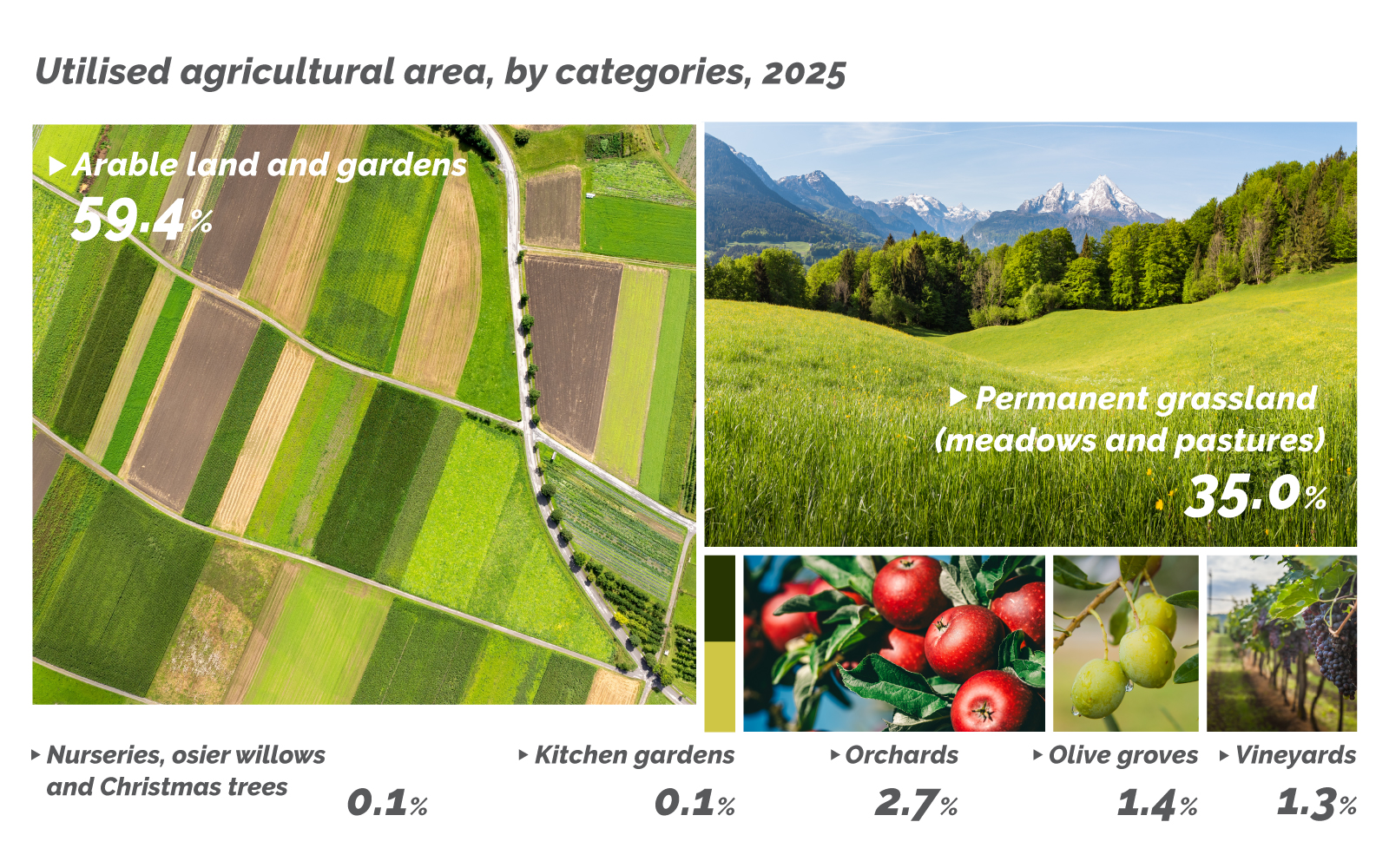
Available agricultural land is the basis for all agricultural activities. More than half of the agricultural land in 2025 were arable land and gardens, while more than a third were permanent grasslands.
The goal of every farmer, whether from a small private family farm or a large agricultural holding, is to place products on the market. The value of purchase and sale of agricultural products in 2025 amounted to 1 541.5 million euro, and out of that the value of sale from own production amounted to 1 000.4 million euro or 64.9%, while the value of purchase amounted to 541.1 million euro or 35.1%. Compared to 2024, the purchase and sale value of agricultural products increased by 4.4%, out of which the value of sale from own production of business entities increased by 10.6%, whereas the value of purchase from private family farms decreased by 5.3%.
In addition to this, there are other economic indicators within agricultural statistics. The value of agricultural production in 2025 amounted to 3 158 million euro, which was an increase of 2.2% compared to the previous year. The gross value added in 2025 amounted to 1 707 million euro, which was an increase of 2.2% compared to the previous year.
When talking about the statistics of this large sector, it should be emphasised that it also includes data from the fields of forestry and fisheries, both of which represent Croatia's great wealth and advantage. Therefore, it is a highly positive fact that the total area of forest land remained at approximately the same level in 2025, as compared to previous years.

There can never be enough discussion about the importance of preserving forests and their resources, and for the purposes of this overview, we present the latest data on the production of forestry products. In 2025, as compared to the previous year, the total quantity of roundwood decreased by 3.5%. Compared to 2024, the production of fuel wood increased by 0.5%, while the production of industrial roundwood (wood in the rough) decreased by 7.1%. The production of logs decreased by 6.3% and of pulpwood by 15.4%, while the production of other industrial roundwood remained unchanged.
Fisheries and aquaculture2)
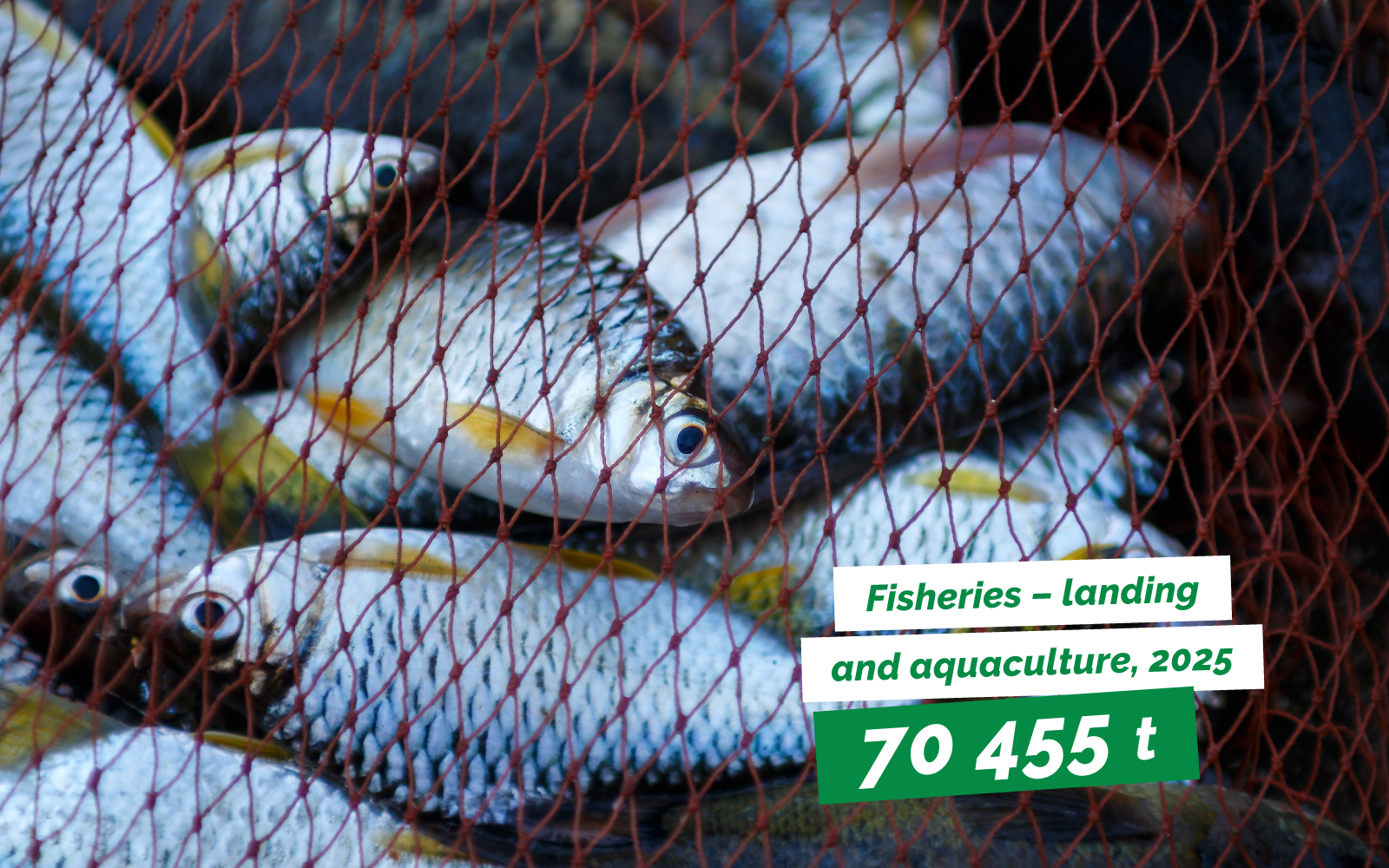
According to provisional data, in 2025, the total landing of fish and other marine organisms decreased by 7.2% compared with 2024, mainly due to a decline in landings of small pelagic fish of 8.3%. This is the result of several factors, the most significant of which is the implementation of management measures for small pelagic fish stocks, which limit catches and landings of small pelagic fish with a view to ensuring sustainable fishing and conserving the stocks. This has ultimately led to the permanent cessation of fishing activities by certain vessels. Fishing activities by the remaining vessels are carried out within the framework of sustainable management measures, with the sector facing additional pressures from climate change. We are witnessing increasingly prolonged periods of adverse weather conditions, which further restrict fishing activities.
The share of small pelagic fish in total landings remained the most significant segment of Croatian fisheries, accounting for 85.7%. Sardine, the most economically important species, accounted for 54.8% of total landings, followed by anchovy with a share of 20.6%. White fish accounted for 7.2% of total landings, with the main species including hake, gilthead seabream, red mullet, anglerfish, common sole and grey mullet.
Marine and freshwater aquaculture are often highlighted as having great potential, primarily due to their importance in healthy nutrition and the fact that the human population is growing worldwide, and sustainable management of fishing resources requires restrictive measures and a reduction in landings. In 2025, marine aquaculture production increased by 5.9%, while freshwater aquaculture recorded a 14.9% increase.
Marine aquaculture in the Republic of Croatia in 2025 accounted for 83.8% of the total farming, with seabass and seabream (white fish), Atlantic bluefin tuna (pelagic fish), and mussels and oysters (shellfish) being the dominant species, while carp, rainbow trout and silver and bighead carp predominate in freshwater farming.
2) Source: Ministry of Agriculture, Forestry and Fisheries – Directorate of Fisheries
← Previous Next →

 Hrvatski
Download data